
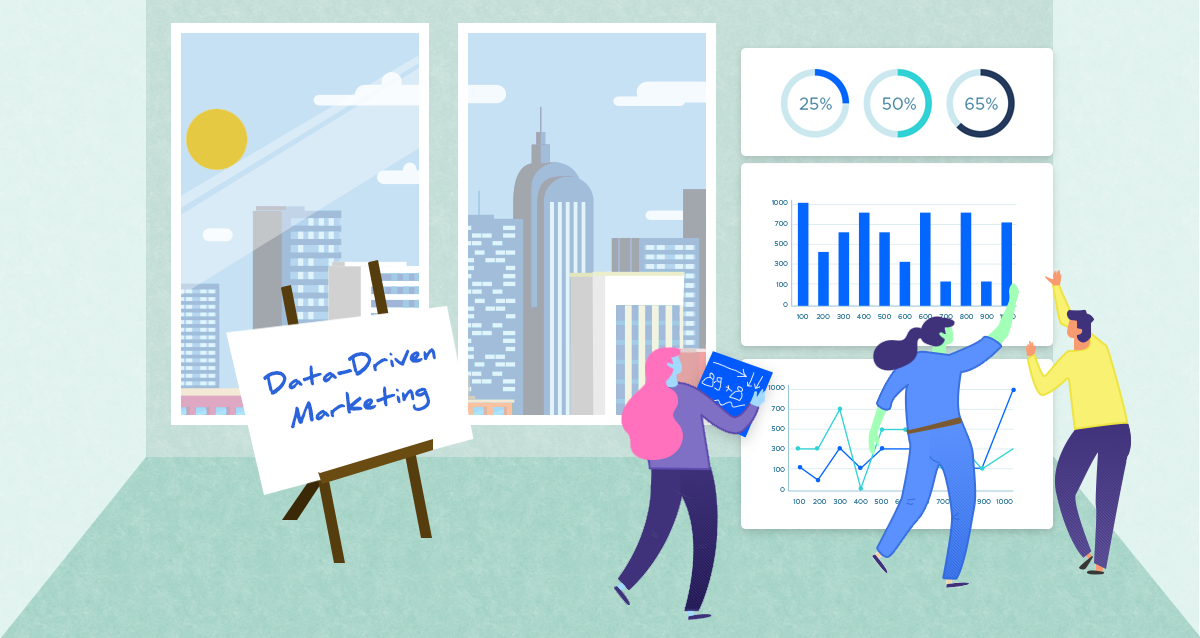
Why Data-Driven Marketing Is Essential for Business Growth
In today’s highly competitive digital landscape, businesses can no longer rely on assumptions, guesswork, or traditional marketing approaches that lack measurable insights. As consumer behavior becomes increasingly complex and digital channels continue to evolve, organizations are required to adopt more structured, analytical, and performance-oriented strategies to remain competitive and relevant. This shift has led to the growing importance of data-driven marketing, where decisions are based on real-time insights, measurable metrics, and continuous performance analysis rather than intuition alone.
Data-driven marketing enables businesses to understand their audience at a deeper level, identify patterns in behavior, and optimize campaigns with precision. Without a data-centric approach, organizations often struggle with inefficient budget allocation, inconsistent results, and missed opportunities for growth. By leveraging accurate data and analytics, businesses can move beyond uncertainty and build marketing strategies that are both scalable and results-oriented, ensuring that every decision contributes to long-term success.
Understanding Data-Driven Marketing
Data-driven marketing refers to the process of collecting, analyzing, and utilizing data from various digital touchpoints to guide marketing decisions and improve campaign performance. This includes data from website interactions, social media engagement, paid advertising platforms, customer behavior, and conversion tracking systems. By integrating these data sources, businesses can gain a comprehensive understanding of how users interact with their brand and where improvements can be made.
Instead of relying on generalized strategies, data-driven marketing allows for highly targeted campaigns that are tailored to specific audience segments. This level of precision not only improves engagement and conversion rates but also ensures that marketing budgets are utilized efficiently. Over time, this approach creates a feedback loop where continuous data analysis leads to ongoing optimization and improved outcomes.

Marketing without data is like driving with your eyes closed—data gives direction, clarity, and control.
Impact on Business Performance
When businesses implement data-driven marketing strategies, they gain the ability to make informed decisions that directly impact performance and profitability. Campaigns can be adjusted in real time based on performance metrics, allowing businesses to identify what works and eliminate what does not. This results in higher conversion rates, improved return on investment, and more effective customer acquisition strategies.
In contrast, businesses that operate without data-driven insights often face challenges such as wasted ad spend, inconsistent lead quality, and difficulty in scaling campaigns. Without clear visibility into performance metrics, it becomes nearly impossible to optimize strategies effectively. Data-driven marketing eliminates these uncertainties by providing a clear roadmap for growth and continuous improvement.
Role of Analytics and Automation
Advanced analytics platforms and marketing automation systems form the backbone of modern data-driven marketing strategies. These technologies enable businesses to capture, process, and interpret large volumes of user data across multiple touchpoints, including websites, advertising platforms, and customer interaction channels. By leveraging this data, organizations can gain actionable insights into user behavior, campaign effectiveness, and conversion patterns, allowing for more precise targeting and strategic decision-making.
When analytics is combined with automation, businesses can build highly efficient and scalable marketing systems that operate with minimal manual intervention. Processes such as lead nurturing, segmentation, retargeting, and performance optimization can be executed automatically based on predefined conditions and real-time data inputs. This integration not only improves operational efficiency but also ensures faster response to market changes, better resource utilization, and consistent engagement across the customer journey.
Conclusion
In an increasingly competitive digital landscape, data-driven marketing has evolved from a strategic advantage into a fundamental necessity for sustainable business growth. Organizations that leverage structured data, advanced analytics, and performance-focused execution are better equipped to understand their audience, optimize campaigns, and make informed decisions that directly impact revenue and long-term success.
By adopting a data-driven approach, businesses can transform marketing from an unpredictable expense into a measurable and scalable growth engine. This shift enables continuous improvement, higher return on investment, and the ability to adapt quickly to changing market conditions, ultimately positioning organizations for consistent and long-term success.
Leave a Reply